
Sad – nay, tragic – news that singer Sheryl Crow lost all of the master tapes from her albums, including her major seller Tuesday Night Music Club, (1993) outtakes and everything, in a fire at Universal’s Archive in Los Angeles in 2008. The fire was covered in the media at the time, but the extent of the devastation only became known after an investigation by The New York Times earlier this year.
Universal told the media at the time that the fire did indeed take place at their famed Universal Backlot facility on June 1, 2008. How fortunate for us that my dear wife Jane, and dear brother and sister-in-law Julian and Mandy had visited that facility the year before. Even more fortunate was the fact that nobody was killed or badly injured in the fire, which started when a construction worker was using a blowtorch on some asphalt during what was already turning out to be a very hot spring season. My dear wife and I were there that year, 2008, and later in June, in the San Fernando Valley (where Universal is situated), temperatures reached 125°F (51°C). I have the proof of that! It was hot, even by California’s standards.
I would love to know how that construction worker feels today, having read the New York Times report.
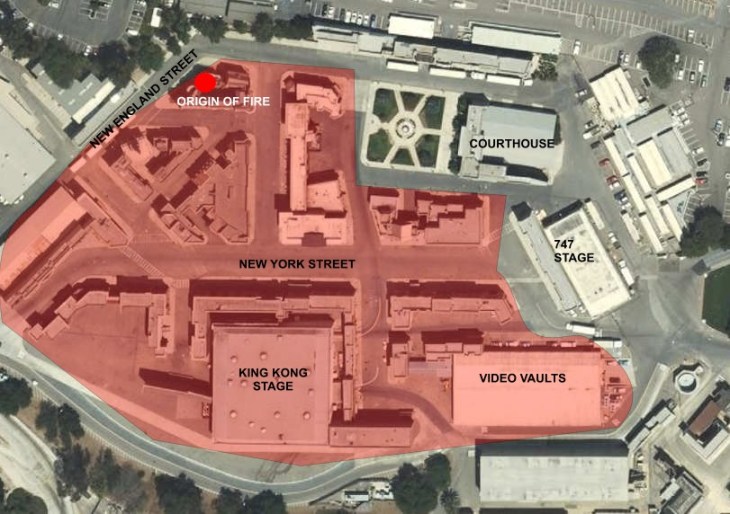
The fire destroyed a number of tourist attractions that I had visited the previous year: The King Kong attraction, the New England Street backlot, the New York Street backlot, and other sets and buildings. Those sets, while of interest to nerdy film historians like myself, could be replaced. Not the end of the world, so to speak.
Far worse, and something that Universal, for whatever reason, decided to keep quiet at the time, was the complete destruction by the fire of an adjoining building, a warehouse called Building 6197, which was a video library containing some 50,000 archived copies of films made by Universal (the oldest of the ‘major’ studios, having been opened as a studio in 1915, and studio head Carl Laemmle began offering tours to the public almost immediately), and of the many smaller companies that Universal had acquired over the decades. In 2008, then studio president Ron Meyer told the media that ‘nothing irreplaceable was lost.’ All of these videos were duplicate copies of titles held elsewhere, apparently.
However, in the same building were master recordings of many albums and singles by music artists from all of the record labels that had been bought by Universal Music Group across the decades. The exact numbers of master tapes is unknown; the estimates range from anywhere between 118,000 and 175,000 analog tapes (i.e., on reels of tape as opposed to digitally held on a computer or a hard drive) of albums and singles of artists recording for Chess, Decca, MCA, Geffen, Interscope, A&M and their many subsidiary labels.
Investigative music journalist Jody Rosen published his article on June 11, 2019 – just two weeks ago, and I read it and wept. All of these master recordings – recordings which are used to create the singles, albums and downloads that you buy today – were totally destroyed in the fire. If you buy a remaster or a remix, they were taken from these tapes. Any outtakes – alternative attempts at songs that were not originally used – as well as dialogue and other musical meanderings, were all gone.
The list of artists – major and some not-so-major – affected is indeed heartbreaking: Aerosmith, Al Green, Al Jolson, Aretha Franklin, B.B. King, Beck, Benny Goodman, Bill Haley & His Comets, Bing Crosby, Bo Diddley, Bobby Brown, Bryan Adams, Buddy Holly, Captain Beefheart, Cat Stevens, Chuck Berry, Coleman Hawkins, Duke Ellington, Ella Fitzgerald, Elton John, Eminem, Eric Clapton, Fats Domino, Guns N’ Roses, Joan Baez, Joni Mitchell, Judy Garland, Les Paul, Lionel Hampton, Lynyrd Skynyrd, Muddy Waters, Neil Diamond, Nine Inch Nails, Ornette Coleman, Queen Latifah, R.E.M., Ray Charles, Sammy Davis Jr., Sheryl Crow, Sister Rosetta Tharpe, Snoop Dogg, Steely Dan, Sting, The Andrews Sisters, The Carpenters, The Eagles, The Four Tops, The Ink Spots, The Police, Tom Petty & the Heartbreakers, Tupac Shakur, Willie Dixon, Yoko Ono…this is just a small sample of the range of artists whose master tapes were all burned to destruction in this fire.
These tapes were priceless. Even since the New York Times article was published two weeks ago, Universal themselves were still being extremely cagey to the media about the extent of the damage. Although we do not know the official reason why the studio decided to cover up the extent of the fire, my own suspicion is that they had made some stupid policy decisions that made the losses even worse.
For example, asked Rosen, why was it that there were no backup copies of these priceless recordings? There were, Universal replied, it’s just that they were all in the same building as the originals! Oh, no! What stupid arrogance from a studio that had already suffered half a dozen previous fires on its backlots: in 1932, 1949, 1957, 1967, 1987, and 1997. Many of their street sets at those times had been destroyed and rebuilt.
But this fire was worse, much worse. Universal Music had placed original master tapes, and their backups, in the same building, no doubt thinking that it’s not going to happen to them, they will deal with it later. Furthermore, many of the artists whose recordings have been destroyed have spoken out in the media about another policy of Universal’s: keeping these mastertapes away from the artists who recorded them. Sheryl Crow is merely the latest in a long line – the fallout from this fire is going to continue for many months or years to come.
Musician Richard Carpenter, one half of the legendary duo The Carpenters (the other half, Karen Carpenter, died in 1983), described how he contacted Universal, wanting to know the whereabouts of his master recordings for A&M Records. Having been fudged by the Universal Music bosses, Carpenter made ‘multiple, persistent’ inquiries as to the whereabouts of these tapes, because he wanted to make remastered editions of his albums and include bonus tracks such as outtakes, or songs that were not used on the original albums. In the end, and only after countless such inquiries, he was told of the fire by a ‘lowly’ studio employee.
Rapper Eminem told the media that he had digitized his master tapes just months prior to the fire, but it sounds like he was very fortunate to be able to have got hold of the tapes at all. Krist Novoselic, bassist for the band Nirvana, said mastertapes for the massive-selling album Nevermind (1991) were ‘gone forever’; while Bryan Adams reported that he, like Richard Carpenter, had asked Universal Music for access to his tapes, only to be informed that the music giant had ‘lost’ and ‘could not locate’ them.
It is the artists that have departed this Earth, those ‘gone forever’, the loss of whose tapes is felt the most, I think. Bing Crosby, Duke Ellington, Al Jolson, Buddy Holly, and many others who died decades ago; great jazz artists and singers, some of the greatest voices and instrumentalists of all time, all of those master recordings, gone. It doesn’t bear thinking about. But it is true, despite what still-fudging Universal Music are trying to cover up.
A number of key artists, Steve Earle, bands such as Hole and Soundgarden, and representatives of the estates of artists such as Tom Petty, Tupac Shakur have begun a Class Action lawsuit against Universal for its actions pertaining to and subsequent to the fire. A class action suit, for those not so informed legally, means that a number of plaintiffs can bring a suit against corporations such as Universal to claim widespread harm, and I believe these plaintiffs can be joined by any number of others at any time, so long as it is agreed by the judge. Another advantage is that, because there are any number of plaintiffs, costs of litigation can be significantly lowered among the parties concerned.
This fire, taken within the context of the entertainment industry, was one of the most significant and dangerous of such fires in all of music history. It is the musical equivalent of The Great Fire of London of 1666. One estimate showed that the master tapes for almost 500,000 songs were gone forever. All of that artistic endeavour, including singers, instrumentalists, other session musicians, writers and producers, all wiped out for eternity. Yes, we have most of the masters on CD, but nothing can be done with those recordings; the recordings themselves cannot be improved, remixed or remastered in any way. No outtakes or unreleased songs, or dialogue featuring these great artists, can ever be released.
And those reasons – combined with the utter corporate shame felt by Universal (which they would never admit, of course) – are why UMG will never come clean about the extent of the losses of their tapes, or indeed their actions that caused the loss to be so great, why they would not let surviving artists touch their own masters before the fire (except Eminem!), or their actions in the coverup itself. Of course, the world understands that this event is not a coverup of the significance of, say, the Iraq War of 2003 or the Kennedy assassination of 1963, but for musicians this is a heartbreaking tragedy.
For their part, after the New York Times article appeared on June 11 this year, UMG issued a statement saying that the article contained ‘numerous inaccuracies’ and misrepresented the scale of the damage. The corporate archivist, Patrick Kraus, told Billboard that the collections of labels such as Chess, Impulse! (John Coltrane and Muddy Waters), and others were not lost; they had, apparently, survived the fire and were still in the archive. However, aerial shots taken in the fire’s aftermath show a building completely razed to the ground. The below image gives you, dear reader, a sense of the scale of the damage. The archive building is to the bottom right of the area covered in red:
That’s all I have for you, folks; be assured that I will continue to update you as events unfold in the coming months and years – this is an ongoing story. Sheryl Crow has discovered that all of her mastertapes of the first decade or so of her career are all gone; doubtless other artists have discovered or will discover similar or worse losses of their own back catalog. Disastrous, disgraceful, dishonest, disreputable – these and many other adjectives can be applied to the fire of June 1, 2008 at the Los Angeles lot of Universal Studios and its corporate archive, held onsite and all in the same building, and their corporate actions subsequent to the fire. At the moment, it is believed that all is lost, in respect of the life’s work of many of the greatest singers, instrumentalists and rappers the world has ever known; there may be some miracle down the line in the future, but at the moment, it doesn’t look good. x
 Stephen Butler - Rant Music
I feel your pain. It’s how I feel when a historical building or ancient site is destroyed.
LikeLiked by 1 person