Boris…

Boris Bloody Johnson, you compel me to write.  I cannot help myself; it’s like a horrendous itch that I cannot scratch.  If that sort of thing would make you laugh and/or feel great about yourself, then whoop-de-doo.  Have a nice laugh on me, mate, and all the rest of the 63% of the population who think you are a simpleton who couldn’t even run to the shop properly, never mind run a country.

In the week since he became Prime Minister, he has been to Scotland, Wales and now Northern Ireland. You may briefly wonder why he did all that, but it shouldn’t take you too long to figure out the answer.

Why, Brexit, of course!

While the UK voted overall to leave the EU by 51.9% to 48.1%, it was a different story among the four nations that go to make up the United Kingdom.

Here in England, we voted in favour of leaving by 53.4% to 46.6%.  Wales, too, voted to leave 52.5% to 47.5%.  But Scotland voted to Remain in the EU by 62% to 38%, by far the biggest majority either way in the United Kingdom, while Northern Ireland voted to Remain 55.8% to 44.2%.

You can look at the results far more closely than that, and look at the counts constituency by constituency.  In that event, you will discover that, in Scotland, not one single Parliamentary constituency voted to leave the European Union. Not a single one.  The constituency results in Northern Ireland were slightly different and reflected in a far more realistic manner the actual percentages of votes either way.

I take it that, in Boris’ first seven days as PM, he has been primed like nobody’s business on the things he needed to do and say (not always necessarily the same), especially where Brexit and the potential deal in terms of departure from the EU are concerned.

I made the point in rather blunt fashion this morning on my social media page at FaceRant, that Boris, intent on delivering Brexit by October 31 deal or no deal, that, in order to fashion a departure from the EU with a deal, he must somehow find a way to include the “Northern Irish Backstop” in the deal, or risk tearing up the 1998 Good Friday Agreement and returning to the days of violence and murder in that province, something I’m sure even he would rather not do.

I’m also sure that I don’t need to explain the backstop in any great detail, but essentially it involves free movement and trade between the UK, specifically Northern Ireland, and the Irish Republic, who are and will remain EU members.

I also don’t need to explain to either of you the fact that the DUP, with its 10 MPs sitting in the current Parliament, are propping up the Conservative minority government right now, because when former PM went to the country in a snap general election in June 2017, she went and lost the Tory majority in Parliament by something like 13 MPs.

And the DUP are against the backstop.  They want a specific ‘hard border’ between Northern Ireland and the South, which should nicely reinflame the differences between those two nations and quickly bring the conflict to a head, and who knows what may happen.

But representatives of the remaining 27 EU member states, including the Irish Taoiseach, will not accept any trade deal with the United Kingdom without the assurance that the backstop will be included as a part of it (the deal).

I don’t like putting too much text in bold and italic, or both, because it tends to draw the eyes to those words and sentences before either of you have had the chance to read the rest of it; but the above sentence ought to be both bold and italic in its entirety.

Because it’s a bit of a choker, that one.  It means that: because the EU will refuse any attempt by the UK government that does not include the backstop, the government negotiators will have to feature it, which means that the DUP, whose votes are vital in Parliament, will not vote for it; ergo, the government will lose any vote in Westminster to get the deal passed into law, unless the Conservatives can garner significant support from its opposition, i.e., Labour and any of the other fringe parties over there, such as the Liberal Democrats.

All of that, in turn, means one of two outcomes for BloJo: either we simply sail past October 31 this year without a deal, which I’m sure is his personal preference (and that of the DUP), or Boris calls another snap general election before the deadline three months from today, hoping that by some miracle he can increase his numbers in Westminster, and have all his MPs whipped to vote in favour of the deal.  Because that’s all that matters right now; no NHS, no schools, no libraries, no transport – just Brexit, bloody Brexit… without Brexit we cannot do anything else at the moment.

Despite the presence of our third unelected Prime Minister in a decade (although Mrs May did “win” a subsequent election, to be fair, despite the loss of the majority), we are no closer to a deal with the EU than we ever were since the Referendum on June 23, 2016.  And, because of that, we face the biggest political crisis – and, who knows, maybe even a social/political crisis, we’ve ever seen in my lifetime, and I can remember the three-day week back in 1973/1974.

Neither are we any closer to the option that I would prefer (and, according to recent polls, a majority of a nation that – shock, horror! – has changed its mind!!!), which is to TEAR UP BREXIT ALTOGETHERapologise profusely to the European Union, and beg fervently to be allowed to come back in and have tea with the rest of the children.

Sorry, Boris, but you have fulfilled your so obvious ambition just at a time when the Prime Minister has been tasked with what seems to be an impossible job.

And please, no more of that “doing what the country voted for” business.  The country didn’t vote for it.  Only half the country voted for it, with a very slight majority in favour of leaving the EU.  With a decision as important as that, it should have been a minimum two-thirds majority, preferably three-quarters.

It seems to me that it will be difficult, if not impossible, that this is all going to be solved and put to bed by October 31.  Even if a deal was to be reached (bwah- hah ha ha ha ha haa ahaaa ha ha ha hah haaaaaa!!!! – Ed.), then the divisions in this country that Johnson’s predecessor in office, David Cameroncaused would fester and burn beneath the surface for years, if not decades, to come.  And who knows, it may well all explode into violent conflict – a scenario that I certainly would never like to see.  x
Fame

My unstoppable rise to world indifference can be characterised in two phases:

First, between the years of about 1976-1983, I wanted to be a rock star, like Elvis.

Second, from 1983 onwards, I wanted to be a rock star, like Elvis, but only in my head.  I just wanted to be rich.

Suddenly, being famous seemed like too unpleasant and painful a concept to be aiming for.  I’ve never heard a famous person yet talk of the joy they feel as a photographer leaps out of a recycling bin, snaps a photo of you cuddling that rent boy with the words cum shot tattooed between his eyes, and the next morning finding that photo plastered all over the front page of the Sunday Sport.

Once I discovered I could write music, that’s mostly all I wanted to do; write.  But, how to make money out of it?  Of course, just as in my obsession with Hollywood, I was once again born at the wrong time.

The days of the ‘Tin Pan Alley’ song – or, its equivalent, the ‘Brill Building’ song – was long gone.  Publishers employed writers to sit all day in offices with a typewriter or a piano to write songs seemed like the dream job for me.

Even better was the Music Department of every movie studio in Hollywood – every major studio had one until the studio system dissolved for good in 1967, the year after I was born.  Being paid to sit in the California sunshine, with a typewriter or a piano, to write songs for movies seemed like the dream job for me.

In September 1938, at Metro-Goldwyn-Mayer, an up-and-coming producer by the name of Arthur Freed was making a new version of the classic L. Frank Baum story The Wizard of Oz (MGM, 1939).  The film was a musical, with a number of new, bespoke songs that, the studio hoped, would be sung across the land: ‘The Jitterbug’ (cut from the final release), ‘Munchkinland,’ ‘If I Only Had a Brain / Heart / the Nerve’, and ‘We’re Off to See the Wizard.’

These songs were all fine, but they had one problem; only one of them, ‘The Jitterbug,’ featured the studio’s fast-rising, extremely-gifted star, Judy Garland, and that was being cut from the film.  At the last minute, they needed a new song for Garland to sing, preferably at the beginning of the film, and they needed it quickly.

The film’s songwriters, Harold Arlen and E.Y. “Yip” Harburg, were told to go away and work on a new song that was to be ready by the following morning.  No pressure, then.

When they returned the following day and played it for producer Freed, he must have fallen from his chair; in less than 24 hours, they had written a song of such unimaginable beauty that it is, to this day, considered one of the greatest songs of all time.

The song was ‘Over the Rainbow,’ and it may be no surprise to both of you that it is my favourite song ever written.  The song appears in the first twenty minutes of the film, while it is still sepia-tone, and Dorothy (Garland) is walking with her dog, Toto after she has failed to get her aunt and uncle to listen to her as she reports the story of an incident in town.  Aunt Em (Margaret Hamilton) tells Dorothy to “go find a place where you won’t get into any trouble!”  Dorothy begins to muse aloud whether such a place could really exist.  Cue ‘Over the Rainbow.’

The song was almost cut after a preview in 1939, after which studio boss Louis B. Mayer and supervising producer Mervyn LeRoy both felt that appearing as it does less than six minutes into the film, the wistful ballad slowed the action down too much, too early into the picture.

Fortunately, that performance was restored into the film and the world got to hear what I believe to be the most perfectly conceived and written song in the history of the genre.

However, there were other performances of the song, far more emotionally intense ones, which were indeed cut, which goes to show the level of musical appreciation that Mayer certainly had – and LeRoy too, to a certain degree.  These remained unreleased until a complete, two-CD version of the soundtrack was released by Rhino Records in 1995.

Few songs can bring a lump to my throat on repeated listenings.  ‘Over the Rainbow’ is one of them that can.  It is heartfelt without being overly sentimental; its lyrics a perfect lesson in word construct, its music an equally perfect lesson in both melody and harmony.  As sung by Judy Garland, it is a lesson in performance, projection, perfectly controlled emotion, and anything else at all where song performance is concerned.  And she recorded it when she was just sixteen years old.

As you can imagine with a song of such unqualified brilliance, there have been many hundreds of cover versions of this song.  None of them, not a single one, come close to Garland’s performance, in my view.  The closest was the now-famous version by Eva Cassidy, who, while a complete unknown, performed it in a bar, filmed by someone in the audience with an amateur video camera.  In one of life’s devastatingly cruel twists, Cassidy developed skin cancer and died, all before she was ever able to enjoy one red cent of the huge income her records – including this performance – were later to generate.

Maybe it was because Cassidy was already dead by the time the world at large got to hear it that the song became such a huge hit for her.  Her performance was magical; expertly played by herself alone on an acoustic guitar, she allowed the vocal to soar and swoop to match the lyrics, without ever making it obvious or trite.  And, of course, there was that extra nuance of other-worldliness with the realisation that Cassidy had already found her place over the rainbow.

Today we worry and fret over the status of copyright in music; but, trust me, in 1939, it was far worse than it is today.  Neither Arlen nor Harburg, creators of this timeless piece of music, received anything more than their standard MGM salary for this song as it appeared in the movie.  The studio practically stole it from under them; a clause in their contract – indeed, everyone at that and all the other major studios in Hollywood – stated that any song or music written for a film, or related to the studio in any way, instantly became the studio’s property once it was performed on screen.  The song’s publication was a different matter; it took composers many years to fight for the income that was rightfully theirs from the publication of their songs, in the days when publication meant publication.  These days, a publication of a song does not necessarily have to mean that the song exists as a printed hard copy of sheet music that you hold in your hand.  It could mean, e-scores, online versions, or anything that constitutes demonstrating to the performer how the song is written.

I wrote at the beginning of this blog that I always believed myself to have been born at the wrong place at the wrong time; nevertheless, had I lived in Hollywood in the 1930s, and been writing songs at the studio – which, let’s face it, would be the only way a jobbing songwriter could earn a living in those days – I would have been shafted, rodgered, buggered good and proper.  I would write a song, Judy Garland would sing it, and Louis B. Mayer would take the publisher’s royalty from that song.  What a racket.

These days, it is both easy and difficult to get your songs heard if you are a songwriter.  There are many online sources to hear new music, but the major services such as iTunes, Google Music and the like, are dominated by the established acts and songs and, unless your song is exceptional, you will find it extremely difficult, if not impossible, to break into that market.

There are many sites that devote themselves to unsigned or unheard songs.  Why?  Because there’s money in it, of course!  There are charges to pay: registration fees, promotion fees, playing fees, and other charges that these companies take from you the more that your music gets played.  Then, naturally, there’s the dreaded advertising.  And, as a songwriter, you are faced with a dilemma: either go for it, and compromise your principles because you believe your songs deserve to be heard by the world, or not, and risk the eternal regret of never having gone for your dream while shelving your ten-thousandth book back on the shelves as you work for nothing as a volunteer in your local community library.  (How local authorities are scamming the very people who voted for them is the subject of a whole other blog.)

When I started writing songs, in the mid-1980s, the best way to get your songs heard was to join a band.  Thus, I was in a number of bands, some who performed covers who got gigs more or less every weekend, and some who played exclusively their own material and generally festered in the guitarist’s bedroom, only allowed out two or three times a year to play a set at your mate’s car boot sale.

Like most songwriters, I guess, I genuinely believe that some of my songs that I wrote with my dear brother Julian Butler are as good as anybody else’s out there.  And maybe one or two songs that I wrote on my own.  I know that Julian has also written a number of numbers on his own that are world-class.  Our last album was released online to major world indifference here.  I would be a fool not to take this opportunity to plug my music, even through this blog with just a couple of followers.  I would rather go for quality over quantity when it comes to followers of my blog and that, folks, is the main reason why my music has never got anywhere; fear of the unknown, perhaps, or maybe a fear that I would not be able to control my own destiny once the songs were out of my hands, or finally, a fear that my arrogant self-belief is unfounded (I don’t believe that it is, though).

Let me leave you for today with this thought: if there is somewhere over the rainbow where my music was known and understood, I would still rather have known the people that I know, loved the people that I love, and be loved by the people that do love me. x


Have I Got News For You…

Yesterday, Boris Fucking Johnson surprised everyone by becoming Prime Minister of the ‘United Kingston,’ as Ivana Trump so eloquently put it.

There are plenty of words in the English language to describe the fear that this puts into the hearts of many; indeed, the man who was not Boris’ ancestor, Samuel Johnson, put enough words into the Oxford English Dictionary back in 1755 to do that job.

Since the Conservative Party came to office in 2010, Boris has become its third Prime Minister.  He is, you will be astounded to learn, educated outside of the British state school system; he went first to Eton, then to Oxford – a bit like David Pig-Fucking Cameron, really.  I dread to think what species of deceased non-human Johnson has had his wicked way with.

Of course, the major political policy that has seen Johnson, like any decent scum, rise to the top, was and is Brexit.

Johnson has said that, although he does not intend to aim for a no-deal Brexit, it would be ‘irresponsible’ not to prepare for that outcome, should it be necessary.  Britain, as both of you know, is scheduled to leave the European Union, and all its benefits, on October 31, which is a Thursday, I believe.

Johnson believes that the UK must leave the EU on that date, with or without a deal.  He thinks that the ‘no-deal Brexit’ is a ‘vital negotiating tool,’ and must be dangled in front of the negotiators from the other nations.

This, in itself, is a measure of Johnson’s delusion.  His idea that, if we threaten the EU with, well, we’ll go without a deal then, they are going to run after us, pleading “No, no, please don’t go!” is crazy at best and an outright lie at worst.

If we have no deal by October 31, the EU will, quite properly in my opinion, merely tell us to fuck off.  Now, I don’t want that to happen.  I would like us to go on our hands & knees, politically speaking of course, and apologise to the EU president, saying, “We’re so very sorry for all the trouble we have caused you.  It was the politically inept and short-sighted half of the population that voted for it, I’m afraid – what can I say?”

I don’t want another thick, croaked animal-fucking Eton spoonfed, Oxford-wasted Tory jerkoff as Prime Minister, thank you very much.

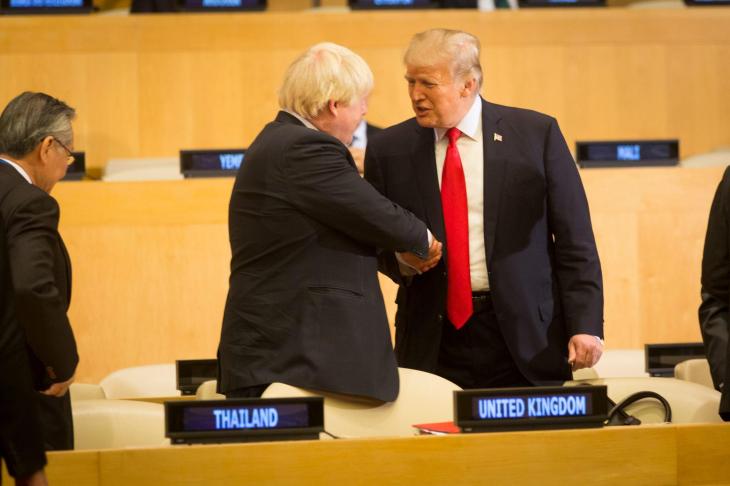
President_Donald_J._Trump_and_the_British_Secretary_of_State_for_Foreign_and_Commonwealth_Affairs_Boris_Johnson_(37425398262).jpg Check this photo out.  It was taken in October 2017 and shows Boris Fucking Johnson shaking hands with Donald Jesushesa Chump at some boring meeting or other, probably the United Nations or some dull fucking nonsense like that.  Trump is the one on the right.  Look similar, don’t they?  It’s going to cause trouble, and I bet you the media will pick up on it soon enough.  I’m amazed at how many things I’ve spotted in the past, and six months later, the media is all over it like they’ve just discovered it!  I expect you have both had experiences like that – you notice that, Christ, they do look alike, don’t they?  Six months down the line, the world’s newspapers will be screaming: “Boris FUCKING Johnson and Donald Jesushesa TRAMP; Two P’s in a Pod!” (P’s – President – Prime Minister?  Get it?  Oh, never mind…zzzzz).  And you’ll be screaming back: “But I was saying that six months ago!”  They also had similar backgrounds, both were TV hosts of the more, er, light-hearted side of things.

Look, I’ll not make this a long one; we all know what time it is, and we all know that both the UK and the USA are going to be royally fucked up the arse with a snapped broom handle from now on.

Let’s hope Boris FUCKING Johnson calls an election, and soon.  And let’s hope he severely misjudges the mood of the nation and fails at the first hurdle to win public backing for his so-called policies.  Because, after all, there’s always the alternative, isn’t there?  Isn’t there?  Isn’t there???  Oh dear, that’s the subject of another blog altogether (cue large crowd saying, ‘That’s the subject of a different blog!’). x

Steely Sudan

This morning, July 12, the BBC released a report that it had put together after weeks of detailed research of an attack by military forces in Sudan on student protesters who had been gathering in the streets of its capital, Khartoum, more or less daily since the previous December.  The BBC could make the report because many protesters had recorded footage of the attack on their mobile phones, making it one of the first military attacks in world history to be streamed live on the internet.  There was next to no ‘official’ footage because news camera crews, paid to do this for a living, could not get near enough to film it themselves.  Forget it, said the students, go home and play on your X-box, we’ll do it ourselves.

I watched the report this morning; it makes for some of the most grim news footage I think I have ever seen.

The attack in question took place on June 3, some five or six weeks ago.  And I would not wish to have been the news team who sifted through the hours of phone recordings to piece together a report that showed its violent nature but didn’t make little Billy barf into his breakfast bowl.  In the end, it was almost impossible not to show a huge amount of violence.  It was a violent, bloody massacre over which the people of Sudan had no control.  Why should we?

The beginnings of the protests, in December 2018, came about because, suddenly and without warning, the price of bread tripled in the northeastern town of Atbara.  The protests, fuelled by social media, spread quickly through other towns, before finally hitting Sudan’s capital, Khartoum.

By February 2019, more than a dozen people had been killed, and more than 800 arrested, in isolated incidents across the country, as the government and military forces – rather than address the causes of the protests – simply squashed the protests as much as they could.  On February 22, Sudanese president Omar al-Bashir announced a year-long state of emergency.  Protesters were calling for his resignation.  Two days later, he was sanctioning raiding the universities, beatings of student protesters and threatening them with 10-year prison sentences if they continued their protests.  The students, showing a great deal of resilience and making the government look very bad indeed, did exactly that – continued their protests.

Then, on April 6, the Sudanese Professionals Association called for a march to the headquarters of the armed forces, the call being answered by hundreds and thousands of protesters.  This was akin to a general strike.  Five days later, on April 11, the protesters got their wish; President al-Bashir was deposed from his job and placed under military house arrest, which you would have thought would have ended the protests, but it didn’t.

Government of the country was taken over by some sort of Transitional Military Council, but that was not what the protesters had fought for.  They wanted civilian rule, not to be beaten, tortured, raped and killed by soldiers acting under the rule of law from the government.

Plus, the Sudanese had another big, big problem, and it was called the Rapid Support Forces, or RSF.  God knows how or why this organisation was formed, but they came from tribal militia out of the Sudanese desert and known internationally for the part that they played in the conflict in Darfur in 2003, often referred to as one of the worst humanitarian disasters of the world.

Already in conflict with the Sudan Liberation Front and the Justice & Equality Movement, the Janjaweed-powered RSF – armed to the teeth by the Sudanese government and ready for action – began a process of government-sponsored ‘ethnic cleansing,’ because non-Arabs were themselves protesting against unfair treatment.  Figures, as always for such tragic events are always difficult to gauge precisely, but the generally accepted figure is that around 480,000 people were killed by the RSF and their pathetic little ‘allies’, while a further three million people were forced into refugee camps housed within the region.  The international community, desperately demonstrating that they were doing all they could to help, signed agreements and held top-level meetings, the results of which were all ignored by the RSF.  Officially, the conflict still rages on today.

So, the RSF are a bad, bad lot.  Although not part of the Sudanese armed forces, they fought on behalf of the government in Darfur, and, on the night of June 2-3 this year, were sent in to Khartoum by the government to end these troublesome protests once and for all.

At around 5 am on June 3, the Sudanese armed forces withdrew, and the RSF took over.  Protesters could see it coming – indeed they tweeted what was happening as it happened.  This inclusion of social media in the conflict was what set it apart from many student and other population protests in the world and in Africa in particular.  Posts on Twitter, Facebook and Instagram began to appear from people caught in the headlights, so to speak, of the Rapid Support Forces, who, almost immediately, opened fire.

From then on, as the BBC reported in their piece this morning comprised entirely of mobile phone recordings, official news sources either withdrew or were forced back, and there was precious little, if any, professional-grade footage of the massacre.  One particularly shocking sequence involved a student who leaned down to pick up a colleague lying face-down on the ground to move him out of the way.  He clearly thought the other man was injured, but in fact the man was stone cold dead.  “Oh my God,!” screamed the student, “they’re killing us!”

And indeed they were.  By the end of the attack, around 118 people were dead, thousands were injured and around 70 women raped by these disgusting apologies for men.  This, the short-sighted, weak-minded military authorities concluded, would see an end to the protests.

But, no.  Oppositions groups called for, and got, a three-day general strike a week later, and other non-violent protests and civil disobediences were staged over the coming days.  The strike was only ended when the military government agreed to free political prisoners.  Victory for the protesters; oh, and the military also agreed to negotiate for a civilian government.  That was quite important, too.

On July 5, a deal was reached between the civil protesters and the military government to share power until a full-on civilian government could be arranged.  This power share would be in place until democratic, United Nations-supported elections could be held in the country in 2022.

The above is a very broad precis of the events that have taken place in Sudan this year.  They show that: governments of all kinds who know they are doing wrong will do anything to hide this from the world, including killing those who are trying to broadcast it on social media.  They know that we know what they are up to, and they don’t care.

Most importantly, they show that the students are incredibly admirable and brave in their resilience in calling for democracy in a country ruled by a dictator and then the military.  They show that civil protest, peaceful demonstration can achieve such a massive amount, but at a cost.  A huge cost.  A lot of lives were lost; we in the United Kingdom could learn a great deal from the Sudanese protesters.  If such resilience were ever demonstrated in the UK, would our military be ordered to open fire on us?  Of course, I would hope not, but there is always that possibility.  But, you notice how the greatest protests are always the most successful in countries where the populace are not fattened up on The X Factor or I’m a Celebrity… dulled into submission by reality television and antipathetic to the point of insentience.

I’m a huge admirer of the protesters in Sudan, and I do urge you to watch the video provided by the BBC but with a caveat; they warn you at least twice before the video begins that it is intensely graphic in its depiction of the story of that fateful day on June 3, and so it is, so watch it at your own peril in that context.  If you can get past it, then the video – and indeed the coverage on social media that inspired it – is a lesson in bravery from a large group of students who were not going to let this awful violence stop them from letting the world know what two successive regimes were doing to them as human beings. I don’t know if it helps them to know that they have the unending support of many from around the world who watch the videos of this appalling violence not because we like it, but because certainly, I felt that watching it was the next best thing that I could do to being a part of it. They certainly are a steely nation in Sudan, so thank you to them for protesting in a way that shows the world how it’s done, but with additional condolences for the most awful price that they had to pay. x

https://www.bbc.co.uk/news/world-africa-48956133

A.I., My Eye!

For some decades, there has been increasing speculation, propaganda, indeed fear, spread in our beloved media emporia concerning the exponentially rapid development of A.I., or Artificial Intelligence.

Artificial Intelligence, for the uninitiated, is the idea that computers, machines and robots can be programmed, or pre-programmed, to think for themselves.

You might assume that computers, in particular, do that already.  However, they don’t.  They work according to algorithms, programming and a form of intelligence that comes specifically and entirely from human programming.  In other words, no ‘thought processes’ are involved.

Giving machines full A.I. is not so simple as it might appear.  There are so many technological, social, psychological, and indeed moral implications, that one cannot simply tap-tap some code and let the computer get on with it.

The late philosopher, Hubert Dreyfuswas something of a critic of A.I., or at least the power that the human race has to create it.  Dreyfus (1929-2017) rejected the notion that the scientific community held that a form of study called ‘Scientific Psychology’ could and should be created, which would detail and explain the workings of the human mind in much the same way that physics is the scientific explanation of goings-on in the exterior world – or indeed the entire Universe.  According to Wikipedia:

Dreyfus’s arguments against this position are taken from the phenomenological and hermeneutical tradition (especially the work of Martin Heidegger). Heidegger argued that, contrary to the cognitivist views (on which AI has been based), our being is in fact highly context-bound, which is why the two context-free assumptions are false. Dreyfus doesn’t deny that we can choose to see human (or any) activity as being ‘law-governed’, in the same way that we can choose to see reality as consisting of indivisible atomic facts … if we wish. But it is a huge leap from that to state that because we want to or can see things in this way that it is therefore an objective fact that they are the case. In fact, Dreyfus argues that they are not (necessarily) the case, and that, therefore, any research program that assumes they are will quickly run into profound theoretical and practical problems. Therefore, the current efforts of workers in the field are doomed to failure.

Dreyfus argues that to get a device or devices with human-like intelligence would require them to have a human-like being-in-the-world and to have bodies more or less like ours, and social acculturation (i.e. a society) more or less like ours. (This view is shared by psychologists in the embodied psychology (Lakoff and Johnson 1999) and distributed cognitiontraditions. His opinions are similar to those of robotics researchers such as Rodney Brooks as well as researchers in the field of artificial life.) [All links are Wikipedia’s.]

Dreyfus doesn’t deny that programming A.I. could take place, he merely argues that there are significant contextual and interpretative obstacles in our ability to do so successfully.

Dreyfus argues against A.I. using two important philosophically-based principles: Phenomenology, which is the study of human experience and our understanding of same; and Hermeneutics, or the methodology by which we humans interpret things, especially what we read.  The key applications of hermeneutics are in the study of texts such as biblical texts, philosophical ones and also other forms of ‘wisdom’ literature.

However, Dreyfus’ record in the field of A.I. study is not good; in two of his books, Alchemy and A.I. (1965), and What Computers Can’t Do (1972), he poured cold water on the optimism within the scientific community about A.I. firstly that a computer would soon beat a human at chess, find and interpret a new mathematical theorem on its own, and that psychological theory (perhaps the most important where A.I. is concerned) could be turned into computer programs.

Dreyfus failed to accept one of the key principles – if not the key principle – of the development of A.I., and that is that the human mind, and/or the human brain, could be compared to a computer software program/human brain of sorts.

So, for example, when Alchemy and A.I. was published in 1965, it was met with ridicule, cynicism and – let’s be honest here – outright hostility from the scientific community.

And, of course, let’s not forget the fact that most of Dreyfus’ key theories were published in the 1960s, when, although computer programming of course existed and was being developed all the time, it was still fairly primitive by today’s standard or the standard at which it was at the time of Dreyfus’ death in 2017.  At the time he went to his grave, Dreyfus could still count on the support of some in the scientific community, but that number was dwindling.

In short, Dreyfus misjudged A.I. research.  He could not have foreseen the fact that an entirely new basis could be found upon which to build the research, which began to occur in the 1980s.  In other words, research into the subject could take place with little or indeed any reference to Dreyfus and his work.

This ‘sub-symbolic’ approach included the development of Computational Intelligence paradigms, such as neural nets – the mimicry of human neural patterns and networks in the brain; using this theory, scientists could look at the development of programming that interpreted, for itself, the human ability for simulated unconscious reasoning.  In this way, a device fired by this kind of programming could, potentially, develop a ‘personality’ or an ‘attitude’ that was entirely its own, and not from any form of human intervention.

This approach also looked at another fundamental for A.I., that of ‘commonsense knowledge.’  This means, for example, that you know that fire is hot, so you don’t put your hand in it.  Experience has taught you not to buy any Travis albums; you know they are going to be shit.

Robotics engineers such as Moravec and Brooks realised in their research that such unconscious reasoning and common sense were obviously going to the be most difficult to get to grips with.  Duh!

Reverse Engineering is an important concept in A.I. research.  The study of existing machines and software is more or less the basis upon which any study, particularly in computing, begins; if you don’t know what’s out there and how it works, how can you develop it?

Fast-forward to today, and an exponentially-rising dystopian view of A.I. in a post-Dreyfusian world, largely propagated by the likes of Elon Musk.

Musk is an extremely important name in the field of contemporary scientific research; largely because he is fantastically rich and can pay for all the scientific endeavour he wants.  I also think it important to state that, when Musk says something, you listen.  He might be as mad as a box of David Ickes, I don’t know; but, even if he is, he knows enough based on the work that he has paid for already, and the work that his company, SpaceX, continue to do.  Musk fears that A.I. could, again potentially at least, discover ways in which to develop its intelligence far, far beyond that of our own understanding; in one video that I watched recently, Musk gravely intoned, ‘Mark my words…’ as he warned humanity of the impending crisis spawned from our desire to develop machines more intelligent than ourselves.

I believe entirely in the concept and possibility of A.I.; it has the same amount of cynicism thrown at it like Wikipedia, from which I have quoted above.  I believe in A.I., and I believe in Wikipedia, indeed the entire concept of wikis, firmly and resolutely.  I would be happy if the entire internet were based on wiki technology.  Wikipedia has an excellent article on artificial intelligence.  I figure if an article such as this has almost four hundred references, a dozen textbook recommendations, and hundreds of resources, further reading suggestions and external links, then the article knows what it is talking about.

Start your reading, if you wish, with this Wikipedia article:

https://en.wikipedia.org/wiki/Artificial_intelligence

…and take it from there.  A.I. is both fascinating and frightening.  What if a ‘species’ of A.I. declared war on humans, with no qualms, compunction or moral compass whatsoever?  We would all be ‘doomed,’ to quote Private Frazer out of Dad’s Army.  It’s the old God/Frankenstein complex, isn’t it?  We, human beings, have created a species that we deliberately programmed to be more intelligent than ourselves turning upon us, marching towards us with that evil red glow in their eye like in The Terminator (1984), and destroying us without any qualms at all.  And that film, by the way, is now 35 years old as of this year.  They can’t say they didn’t warn us. x


Kim Jong-trump & Rant Round-Up

Well, he was passing, so he thought he would drop in.

Kim Jong-trump had just spent a few days resting and relaxing in Japan with the other G20 world leaders, so he made a phone call to his mate Donald Un and asked if he could pop over for tea and hobnobs at Kim’s place; Kim calls his pad “North Korea,” and his front garden wall the De-Militarized Zone, or DMZ for short.  I always thought that was a pop music entertainment website but, hey, I could be wrong.

A number of years ago, when I used to rant multiple times a day on Facebook, I asked the question, why is it that US Presidents always go for oil-rich nations like Iraq, while ignoring countries whose dictators are equally as bad, except that there are no rich natural resources to plunder.  Well, President Donald J. Trump has certainly redressed that balance, hasn’t he?

The big question has to be, what on Earth do they talk about?  It seems that the biggest fear the Trumpeter has is that the North Korean regime might actually have real nuclear weapons that could realistically reach real real estate in North America.  Who cares about the rest of the world?

Every US president must have a legacy.  I think they have to have a presidential library, too, but it’s difficult to imagine the Trumpster reading, actually reading a book.  Anyway, a legacy is the most important thing.  Something everyone will remember them for.

For Trump, his legacy must sho’ nuff be North Korea, and, as of today, becoming the first US President in history to visit on North Korean soil.  But what has Trump achieved?  Nothing, of course, most of us knew that he was full of hot air and bullshit, apart from the 62 million people who voted for him.  Less than Hillary Clinton, but them’s the rules.  Besides, I would rather listen to a Travis album than have either of them – Trump or Clinton – as a president of my free world.

***********

Pop princess Taylor Swift has become the latest in a long, long, long line of performers and/or songwriters who have found themselves shafted by one or more person(s) at the so-called ‘business end’ of the so-called ‘music industry.’

Some may not recall this, and it does seem a million years ago, but, once upon a time, Taylor Swift was actually a country singer.

She signed to a brand new label in Nashville called Big Machine Records.  Indeed, founder Scott Borchetta hadn’t even set the label up when he approached Swift, promising her that she would be his first signee when everything was finalised with his label.  It was, and she was.

So country was she that her first single was entitled, ‘Tim McGraw.’  Everything was going swimmingly for Swift until she asked for – and was repeatedly denied – the option to buy the rights to her own work.  Her album’s master tapes, essentially, and the right to do whatever she wanted with them.

“You can’t,” Big Machine Records told her.

“Why not?” she asked.

“Because we want them,” Big Machine Records replied.

“Hang on, I’ll get my contract.  …blah blah…here we are…Big Machine Records will own the rights to all masters recorded by the Artist from now until whenever the Label sees fit to terminate the option…blah blah blah…I can’t believe it!”

“You signed it,” smirked Big Machine Records.

“But I was fifteen years old!!!” wept Taylor.

“Doesn’t matter what age you were, or what understanding you did or didn’t have of the legality of what you were signing.  You signed it, and it’s legally binding.  Now fuck off.”

Never was a record label more appropriately named.  Taylor Swift ended up recording six albums for that label, and though she has now left them, she cannot do anything with them, and she cannot control what anyone else sees fit to do with them, such as release an endless stream of Greatest Hits albums that completely flood the market and make the record-buying public entirely sick of Taylor Bloody Swift, if they aren’t already.

**********

More on the pop industry:  Legendary rock festival Glastonbury was back on our festival calenders this year after taking a year off in 2018.  It was good to see it back; but when artists such as Kylie Minogue occupy the ‘Legend’ slot on a Sunday afternoon, you know it’s been a fallow year.

Now, I’ve nothing against Kylie playing Glastonbury.  As many of the two of you will know, Ms Minogue was scheduled to play the festival back in 2005, when, at the age of 38, she was cruelly struck down with breast cancer at the moment that should have been her greatest triumph.

On that occasion, she was scheduled to headline the event.  So why was she not given that opportunity in 2019?  Why the cheesy ‘Legend’ slot, previously filled by the likes of Lionel Richie and Jeff Lynne’s ELO?  Perhaps the organisers were too busy signing the headlining contracts with the likes of Stormzy and The Cure to notice. Besides, legendary gospel singer Mavis Staples was already on the bill on Sunday, why didn’t she fill the ‘Legend’ slot?

**********

Of course, headline news this morning (July 3, 2019) was the defeat of England’s Lionesses by the mighty USA in the 2019 Women’s World Cup football tournament.

Unlike their male equivalents, this England squad, coached and managed by former Manchester United star Phil Nevillecan hold their heads high this morning, despite a 2-1 defeat by the defending champions and, in all honesty, most likely the champions of this tournament as well.  England still have everything to play for on Saturday, by beating either Denmark (most likely) or Sweden in the 3rd place play-off.  As Mr. Neville said to the media, the 2019 Women’s squad really did leave their hearts on the pitch at the end of a furious and fast-paced game from start to finish; but, as Mr. Neville didn’t say, the Lionesses also taught the men the value of not just physical hard work but emotional as well.  They worked hard, for each other, and provided a match that was exciting to watch.  Unfortunately, and this is something that they could not control, the usual Elements of Fate came into play where England are concerned.  And last night, we had it all.

First of all, this was the first major tournament that I have seen in which V.A.R. (Video Assistant Referee) was used as an essential and integral feature of the game.  If you have no idea about football, and care not two shits about it, I’ll be brief: V.A.R. is set up to assist the person who is now known as the ‘head referee,’ and there are about half a dozen staff in an off-pitch office watching any incident that is questioned from every possible angle.  If a decision by the ‘head ref’ is disputed, then it goes to V.A.R., who pass a final judgement.  Furthermore, the head ref has a video screen at the side of the pitch, from which they can watch replays of the incident.

Players and pundits have been calling for this for years and, now that it’s here, is it working?  Well, yes and no.  And this is where the thought that, oh no, here we go again comes in.  With the score at 2-1 to the USA, England scored a goal early in the second half that, in 99 cases out of 100, would have been given.  But no, just because it is second nature for defenders to wave their arms in the air and claim offside, in the hope that the referee shares that view, the decision went to V.A.R.  England had already run around the pitch showing off Ellen White’s now well-known goal celebration; a nod to Cologne striker Anthony Modeste.  Yes, the goggles thing.

The decision came back: goal disallowed.  Absolutely typical.  Why?  Because at the moment she received the ball, Ellen White was literally the width of a boot offside.  I was yelling my head off, frightening the cats having sex under my living room window, at this mental decision – correct by the letter of the law, perhaps, but not in the spirit of the game.

England seemed to fall apart after that.  And how many times in major tournaments in my entire lifespan (since the World Cup of 1966) have we seen that?  One decision goes against us and our spirits turn to jelly.

Next, came the penalty.  This time, V.A.R. worked in England favour.  Ellen White was brought down in the box, it went to V.A.R., and the decision came back – penalty to England.  Captain Steph Houghton stepped up and parried a weak shot straight into the goalkeeper’s arms, thank you very much.  Still 2-1, and still England cannot score.  There is actually a psychological condition that has a name that affects anyone who puts on an England football jersey.  It’s called The Penalty Curse, and, basically, the symptoms include: palpitations, sweat, jelly legs, and making crazy decisions that seem entirely rational and normal to you at the time, such as gifting the bloody ball straight to the f***ing goalkeeper!!!  We’ve seen it time and again for England in World Cups, and in European Championships – famously against Germany, of course, beaten by them in a penalty shoot-out twice; once in Italy in 1990 and then in Euro 96 semi-final at Wembley Stadium in a night of heartbreak for current England manager Gareth Southgate.

Thirdly, there was the Sending Off.  Millie Bright had been yellow-carded in the first half of an increasingly fractious game, so the England centre-back needed to be very careful throughout the rest of the game; no silly tackles, no rash challenges – you know the drill. But, almost on cue, Bright was sent off for a second yellow card in the 87th minute.  Perfect.  Because V.A.R. had been used twice in the second half, the head ref added on seven minutes of added time, so England was forced to play almost 11 minutes (plus extra time if needed, ha ha ha!) with ten women.

The more this technology is used, the more games will be delayed by a considerable amount and – who knows – ten, fifteen minutes added on at the end of a game.  Personally, although I accept that it does remove the ambiguity of certain key decisions, is that enough of a justification for holding up play to such a degree that players can go off and write a novel?  Not in my opinion.  Bring back the old fun of referees getting it wrong!  So, England suffered all three of their major bugbears in 52 minutes of football.  And I’ll not even go into all the tactical and preparational reasons why the USA were so dominant against England, and indeed throughout the entire world of women’s football.  But it does lead me to question why it is that the men of the USA cannot exercise the same dominance?  Perhaps we shall never know.  For now, though, one could not help but admire the strength, organisation and tactics of the American team, especially their captain, Alex Morgan, not to mention their stunning keeper, who made several absolutely world-class saves last night – Alyssa Naeher.

**********

Well, I hope you enjoyed this quick rant-up of the current news events, I appreciate that it is only a taster but if I don’t stop now, I shall never get this perishing thing online and people will be reading it, thinking what World Cup?  So I shall bid you a fondle farewell and see you on the far side of town. x